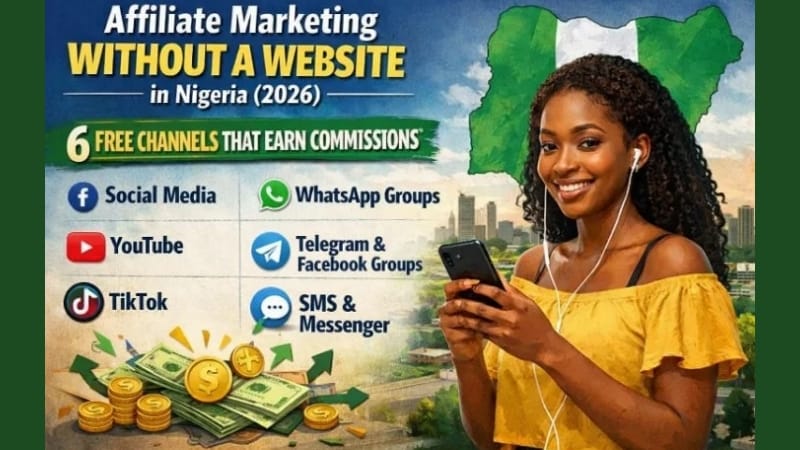
Affiliate Marketing Without a Website in Nigeria 6 Free Channels You Can Start With
You do not need to build a website before you can begin affiliate marketing. You can start by using channels where people already spend time — but the important skill is not simply getting an affiliate link. It is learning how to attract the right people, provide useful information, recommend relevant offers and follow up properly.
Can You Do Affiliate Marketing Without a Website in Nigeria?
Yes. A website is useful, especially when you want to build long-term search traffic, but it is not a requirement for starting affiliate marketing. You can use WhatsApp, TikTok, Instagram, Facebook Groups, YouTube and email to attract an audience and introduce relevant affiliate products.
However, there is an important difference between having an affiliate link and knowing how to sell. Your results depend on factors such as the product, audience, trust, content quality, offer relevance and your ability to follow up. There is no guaranteed number of days or sales.
- Why you can start affiliate marketing before building a website
- Six practical channels for promoting affiliate offers
- How to use WhatsApp Status without simply dropping links
- How TikTok, Instagram and YouTube can support affiliate content
- How Facebook Groups can be used without becoming a spammer
- How an email list can become an owned audience
- How to choose affiliate products that actually fit your audience
- A simple 7-day setup plan for a beginner
- When adding a website becomes a smart next step
Why You Do Not Need a Website to Start
A website is one way to build an affiliate marketing business, but it is not the only way.
Affiliate marketing is fundamentally about connecting a relevant product or service with people who may genuinely need it. Your website can help you attract those people through search engines, but social platforms, messaging apps, communities and email can also bring attention to your recommendations.
The important distinction: starting without a website does not mean you can skip marketing. You still need an audience, useful content, trust, a relevant offer and a clear next step.
In fact, starting without a website can help a beginner learn an important part of affiliate marketing: how people respond to offers. You can learn which problems people ask about, which content attracts attention, which recommendations generate questions and where people stop before buying.
Later, those lessons can help you build better website content because you already understand what your audience actually cares about.
Channel 1: WhatsApp
WhatsApp — Turn Attention Into Conversations
WhatsApp can be a useful starting point for Nigerian affiliate marketers because you may already have contacts who know you. But that does not mean every contact is automatically a buyer.
The mistake is to think: "I have an affiliate link, so I should send the link."
A better approach is to first understand the problem your chosen product solves, create useful content around that problem and invite interested people into a conversation.
Try this simple 3-part Status sequence
Start with a useful lesson
Teach something genuinely useful about the problem you are addressing. Do not start with an affiliate link.
Address a common mistake
Explain something your audience may be doing incorrectly. This helps people understand the problem more clearly.
Introduce the relevant resource
If a product genuinely solves the problem, explain why you think it may be useful. Then provide the appropriate link or invite the person to ask you for more information.
"I've been talking about [problem] because many people struggle with it without realizing exactly where they are getting stuck. If you're trying to solve this yourself, I found a resource that explains the process more thoroughly. If you'd like to see it, send me a message and I'll explain what it covers."
This approach gives you an opportunity to understand the person's needs before immediately pushing an affiliate offer.
Do not treat WhatsApp contacts as a list of people to advertise to. Treat them as people. Share useful information, respect their attention, and only recommend products that genuinely fit their needs.
Channel 2: TikTok
TikTok — Build Attention Through Useful Short Videos
TikTok can help you reach people who do not already know you. That makes it different from your existing WhatsApp contacts.
Instead of making every video an advertisement, create short educational content around the problem your chosen affiliate product addresses.
Hook the right person
Start with a specific problem, question or mistake your target audience recognizes.
Teach something useful
Give one practical lesson instead of trying to explain an entire course in a short video.
Give one clear next step
Invite viewers to your relevant guide, free resource, profile link or conversation. The next step should match what the video promised.
Do not build your TikTok strategy around virality. Build it around relevance. A smaller audience interested in the exact problem you solve can be more useful than a large audience that does not need your offer.
You can also repurpose useful short-form content for Instagram Reels, YouTube Shorts and WhatsApp Status, provided you adapt it to the platform rather than posting blindly everywhere.
Channel 3: Instagram
Instagram — Reels for Discovery, Stories for Relationship
Instagram can work well when your affiliate niche benefits from visual demonstrations, examples, screenshots, tutorials or before-and-after explanations.
- Reels: Use short educational videos to introduce your ideas to people who do not yet follow you.
- Stories: Use them to continue conversations with people who already follow your content.
- Profile link: Send interested people to one relevant destination rather than presenting a confusing collection of links.
For example, if your niche is website creation, you might publish a Reel explaining a common beginner mistake, then direct interested viewers to a useful tutorial. If an affiliate tool is genuinely relevant to that tutorial, it can be introduced naturally.
Do not assume a particular percentage of viewers will click, buy or generate a certain amount of commission. Those numbers vary greatly by audience, content, product, price, trust and many other factors.
Channel 4: Facebook Groups
Facebook Groups — Help First, Recommend When Relevant
Facebook Groups can put you close to people who are already discussing the problem your affiliate product solves.
But this is exactly why careless affiliate promotion can backfire. People join communities for discussion and help, not to receive a constant stream of promotional links.
What to do instead
- Read the group's rules before posting.
- Answer questions genuinely.
- Share useful explanations without always promoting something.
- Recommend a product only when it actually fits the question.
- Disclose when your recommendation contains an affiliate link.
- Never repeatedly drop the same affiliate link across unrelated posts.
"The issue you're describing is mainly about [specific problem]. I'd suggest first fixing [specific step]. If you also want a more structured walkthrough, there is a resource I know that covers this topic. I may earn a commission if you purchase through my link, so please check whether it actually fits what you need."
This is much stronger than joining a group today and immediately posting "Make money online — click my link."
Channel 5: YouTube
YouTube — Tutorials Can Continue Attracting Viewers
YouTube is particularly useful for affiliate marketing when people need an explanation before deciding whether a product or tool is right for them.
You do not necessarily need expensive equipment. Depending on your niche, you can create screen-recorded tutorials, demonstrations, slide-based explanations or voice-over videos.
A useful tutorial might explain how to use a software tool, compare two services, demonstrate a workflow or solve a specific beginner problem. If the tool being demonstrated has an affiliate programme, the relevant disclosure and affiliate link can be placed where appropriate.
Think of YouTube as a library, not a lottery. One video may perform poorly while another becomes a useful source of search traffic. Focus on solving specific problems consistently rather than expecting every upload to generate commissions.
Channel 6: Email Marketing
Email — Build an Audience You Can Nurture
Email is different from social media because the relationship does not depend entirely on an algorithm deciding who sees your next post.
You can start without a traditional website by using a landing-page or funnel platform to collect email addresses in exchange for a useful free resource.
A simple no-website email setup
Create a useful free resource
Give people a genuine reason to subscribe. It could be a checklist, short guide, worksheet or beginner tutorial connected to your niche.
Create a simple opt-in page
A landing page can collect the subscriber's email address without requiring you to build a full website first.
Send useful follow-up emails
Teach, answer questions and address common mistakes before making product recommendations.
Recommend relevant products
When a product genuinely helps with the problem you have been discussing, explain why it may be worth considering and disclose your affiliate relationship.
ClickStartNG also uses this principle with its own free resources: teach first, build trust, then present the next useful step.
🎯 Want to Learn Affiliate Marketing the Right Way?
Start with the fundamentals instead of collecting dozens of affiliate links. Learn how product selection, content, traffic, conversations and follow-up fit together.
Compare the Six Channels
There is no single "best" channel for every affiliate marketer. Choose according to the type of audience you can reach and the type of content you can consistently create.
| Channel | Strength | Best Use | Main Challenge |
|---|---|---|---|
| Direct conversations | Warm audience + follow-up | Limited to your network unless you grow it | |
| TikTok | Content discovery | Short educational videos | Requires consistent content |
| Visual discovery + relationship | Reels and Stories | Requires consistent content | |
| Facebook Groups | Existing communities | Questions and niche discussions | Group rules and spam risk |
| YouTube | Searchable video library | Tutorials and demonstrations | Content can take time to gain traction |
| Direct follow-up | Nurturing subscribers | Requires people to opt in and engage |
You do not have to master all six channels at once. Start with one primary channel, learn how your audience responds, then add another channel when you have a repeatable content process.
How to Choose Affiliate Products
One of the biggest mistakes beginners make is choosing a product because the commission looks attractive.
Commission matters, but it should not be the first question. The better question is:
"Does this product genuinely solve a problem for the people I can reach?"
Before promoting an offer, check:
- Audience fit: Would the people following you actually need this product?
- Product quality: Have you studied what the customer actually receives?
- Clarity: Can you explain what problem the product solves without exaggerating?
- Price: Is the price reasonable for the audience you are recommending it to?
- Vendor reputation: Does the vendor appear legitimate and provide appropriate customer support?
- Affiliate terms: Are you allowed to promote the offer on your chosen channel?
- Disclosure: Can you clearly tell your audience that you may earn a commission?
Do not choose products simply because someone says they are "hot", "guaranteed", "fast-selling" or capable of producing a particular monthly income. Your audience needs a relevant solution, not a marketing slogan.
Your 7-Day Setup Plan
The purpose of this plan is not to promise a commission within seven days. The goal is to use one week to build the basic system and begin learning from real audience responses.
Select one niche and one relevant product
Identify one audience problem and choose one affiliate offer that genuinely addresses it. Read the product information carefully.
Learn the product before promoting it
Understand who it is for, what it contains, what it does not contain, the price, refund terms and affiliate rules.
Create your first useful piece of content
Answer a real question related to the problem. Do not make the content an advertisement.
Invite questions
Use WhatsApp Status, social content or another channel to invite people who have the problem to ask questions or learn more.
Recommend only when relevant
Explain why the product may help. If you use an affiliate link, disclose the relationship clearly.
Follow up with interested people
Answer questions and objections. Do not pressure people who are not interested.
Study what happened
Which content received attention? What questions did people ask? Where did people lose interest? Use those lessons to improve your next week.
When Should You Add a Website?
Starting without a website does not mean you should avoid websites forever. A website can become a valuable long-term asset because it allows you to publish searchable content, build topical authority and create a central destination for your audience.
Consider adding one when:
- You have identified a niche you genuinely want to continue serving.
- You understand the questions your audience repeatedly asks.
- You have enough content ideas to build a useful resource library.
- You want to build traffic from search engines over the long term.
- You want one central home for your guides, resources, offers and brand.
Do not wait for a website before learning how to sell. But also do not assume you will never need one. The two approaches can complement each other.
Three Mistakes to Avoid
1. Starting With the Affiliate Link
Your audience does not wake up wanting your affiliate link. They have questions, problems, goals and concerns.
Start with the problem. Teach something useful. Understand the person's situation. Then introduce a relevant resource.
2. Promoting Products You Do Not Understand
If you cannot explain what a product does, who it is for, its limitations and why you recommend it, you are not ready to promote it confidently.
Study the product before asking someone else to spend money on it.
3. Expecting Immediate Results
Affiliate marketing has variables you cannot completely control: audience size, product demand, trust, content quality, price, competition, platform distribution and the vendor's sales process.
Therefore, do not judge your entire affiliate business because you did not make a commission in seven days. Study the process, improve your content and continue learning from real responses.
Frequently Asked Questions
Can I do affiliate marketing without a website in Nigeria?
What is the best no-website channel for a beginner?
Can I promote affiliate links on WhatsApp?
Do I need money to start affiliate marketing without a website?
How long does it take to make an affiliate commission?
Should I build a website eventually?
Conclusion: Start Without a Website, But Build a Real System
You do not need a website before you begin affiliate marketing in Nigeria. WhatsApp, TikTok, Instagram, Facebook Groups, YouTube and email can all help you reach people and introduce relevant products.
But the real skill is not collecting affiliate links. It is understanding a problem, creating useful content, attracting the right audience, starting meaningful conversations, recommending an appropriate solution and following up professionally.
Start with one audience, one problem, one relevant offer and one primary channel. Learn from the market. Improve your process. Then expand.
Learn first. Build trust. Recommend relevant solutions. Sell ethically.
🚀 Read These Next
Affiliate Disclosure: Some links on ClickStartNG may be affiliate or referral links. If you purchase or register through an eligible link, ClickStartNG may receive a commission at no additional cost to you. We recommend products based on relevance to the topic and encourage you to review the product, pricing, terms and suitability before making a purchase.