
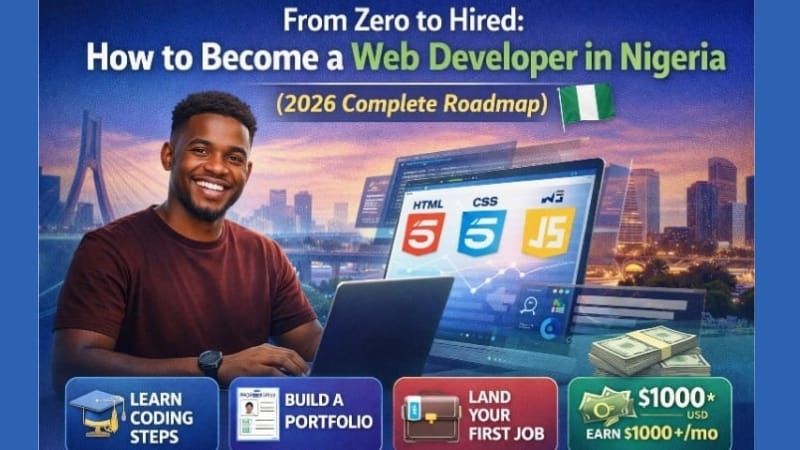
From Zero to Hired: How to Become a Web Developer in Nigeria (2026 Complete Roadmap)
- Why web development is one of the highest-paid digital skills in Nigeria in 2026
- The exact 9-month learning roadmap — month by month, skill by skill
- Frontend vs Backend: how to choose your specialisation and what each pays
- Every skill you need with free learning resources linked for each one
- Nigerian web developer salary guide — from junior to senior to international remote
- How to build a portfolio that gets you hired, with specific project ideas
- Where to find web development jobs and clients in Nigeria in 2026
- How to earn freelance income from web development before you are even “job-ready”
You do not need a university degree. You do not need expensive equipment. You do not need to travel to a tech hub in Lagos. Web development is one of the few technical skills in 2026 where a self-taught Nigerian with a laptop, a data connection, and consistent daily practice can go from complete beginner to earning ₦150,000+ per month within nine months — and the industry data backs that up: over 80% of working Nigerian developers are self-taught.
The Nigerian tech industry is experiencing sustained growth, with companies actively hiring developers and the opportunity to work remotely for international companies paying in dollars genuinely available to skilled Nigerian developers. But most guides written about web development are generic and Western. This one is written specifically for the Nigerian context — the right tools, the right platforms, the right salary benchmarks, and the right job-hunting strategy for the Nigerian market in 2026.
Why Web Development in Nigeria in 2026
Every Nigerian company that wants to be taken seriously needs a website. Every startup raising investment needs a web presence. Every e-commerce business, every coach, every content creator, every law firm, every clinic, and every school needs a website that actually works. And most of them cannot build one themselves.
That gap — between the demand for websites and the supply of people who can build them — is where Nigerian web developers are earning, and where new developers entering the field in 2026 have the best opportunity in years.
Why Web Development Specifically?
- Fastest path from zero to income: A junior web developer with six months of consistent practice can start earning ₦80,000–₦150,000 per month. Few other skills provide this combination of speed and earning potential.
- Freelance income alongside a job: Web development skills let you take on client projects independently. Many Nigerian developers earn more from freelance work than from their day jobs within two years of starting.
- Remote work genuinely accessible: Unlike many Nigerian career paths, web development allows remote work for international companies paying in dollars — a significant advantage at current exchange rates.
- Skills compound over time: Every project you build makes the next project faster. Developers who start today are significantly more valuable in 12 months than they are now, and the salary increases reflect that progression.
- No degree required: Every major Nigerian tech employer evaluates web developers on their portfolio and ability to write working code — not their academic certificates. Your work speaks louder than any degree.
Web development is one of the highest-earning digital skills for Nigerians. See how it compares to other in-demand skills in our guide: 10 Digital Skills Nigerians Can Learn in 30 Days.
The 9-Month Learning Roadmap: Month by Month
This roadmap is designed for someone starting with no programming experience and committing to 2–3 hours of daily practice. Skip ahead if you already have foundation knowledge, but do not skip the practice projects — they are what separate developers who get hired from those who only watched tutorials.
Months 1–3: Foundation Phase
HTML, CSS & JavaScript BasicsThis phase builds the fundamental skills that underpin everything in web development. Every website on the internet is built with HTML (structure), CSS (styling), and JavaScript (interactivity). You cannot skip this phase — it is the soil everything else grows from.
Month 1 — HTML and CSS fundamentals:
- HTML5 semantic structure — headings, paragraphs, links, images, forms, and semantic tags like <article>, <section>, and <nav>
- CSS3 styling — colours, fonts, spacing, borders, and how to make things look exactly the way you want
- CSS Flexbox and Grid — the two modern layout systems that replace older, messier approaches
- Responsive design — making websites look correct on phones, tablets, and desktops using media queries
Month 2 — JavaScript fundamentals:
- Variables, data types, functions, loops, and conditional logic
- DOM manipulation — how JavaScript changes what you see on a webpage
- Events — making things happen when users click, type, or scroll
- Fetch API basics — how websites communicate with servers to get data
Month 3 — Git, GitHub, and first projects:
- Git version control — saving your code history and collaborating with others
- GitHub — the platform where every developer stores and shares their code
- Deploy your first website free using GitHub Pages or Netlify
Build these three projects before moving to Phase 2: (1) A personal portfolio page with your name and brief bio. (2) A clone of a simple Nigerian business website. (3) A JavaScript to-do list with add and delete functionality. Each project should be live online and linked from your GitHub profile.
Months 4–6: Specialisation Phase
Choose Your Path: Frontend or BackendAt this point you know enough to build simple, functional websites. Now you specialise. The two main career paths in web development are Frontend (what users see) and Backend (what happens behind the scenes). Choose one and go deep — trying to do both simultaneously at this stage slows your progress significantly.
What users see and interact with
- React.js — the most in-demand frontend framework in Nigerian tech companies
- SASS/SCSS — improved CSS for complex projects
- TypeScript basics — typed JavaScript for larger codebases
- API integration — fetching and displaying data from backend services
- Accessibility — building sites usable by all Nigerians including those with disabilities
What powers websites behind the scenes
- Node.js + Express — JavaScript on the server (recommended if you enjoyed JS in Phase 1)
- PHP + Laravel — widely used in Nigerian WordPress and business applications
- Python + Django/Flask — excellent for data-driven applications and APIs
- Databases — MySQL for structured data, MongoDB for flexible data
- REST APIs — how backend services communicate with frontend applications
If you enjoyed making things look and feel right during Phase 1, choose Frontend. If you were more interested in the logic, data, and how things work behind the scenes, choose Backend. Both paths pay well in Nigeria. Frontend has slightly more entry-level openings; Backend commands higher salaries at senior level. You can always learn the other side later as a full-stack developer.
Months 7–9: Job-Ready Phase
Portfolio Development & Professional PreparationThis phase shifts focus from learning to demonstrating. Employers and clients do not care how many tutorials you have watched — they care what you have built. Month 7–9 is dedicated to building 3–5 substantial projects, learning to test and deploy them professionally, and preparing for the interview process.
- Build 3–5 impressive portfolio projects that solve real problems — not just tutorial clones
- Learn basic testing — Jest for JavaScript, so you can prove your code works
- Learn deployment — Netlify and Vercel for frontend; Railway or Render for backend
- Master technical interviews — practice coding challenges on HackerRank and LeetCode daily
- Polish your GitHub profile — every repo should have a README, live demo link, and clear code
- Build your LinkedIn presence — connect with Nigerian tech recruiters and hiring managers actively
- Start applying and freelancing — do not wait until you feel “completely ready”; begin Month 8
The goal of Month 9: Land your first web development job paying ₦80,000+ per month, or secure your first paid freelance client worth at least ₦50,000. Both are achievable with consistent 9-month effort.
Essential Skills & Where to Learn Each One Free
HTML & CSS
The foundation of every website. HTML structures content; CSS makes it look professional.
Free on freeCodeCamp + MDNJavaScript
Makes websites interactive. Required for both frontend and backend development.
Free on javascript.infoReact.js
The most in-demand frontend framework in Nigeria and globally. Essential for modern web apps.
Free on react.dev + ScrimbaNode.js
JavaScript on the server. Lets you build complete full-stack applications with one language.
Free on nodejs.org + YouTubeGit & GitHub
Version control is non-negotiable. Every developer must know how to use Git from Day 1.
Free on GitHub Skills platformResponsive Design
Building websites that work perfectly on Nigerian smartphones — essential for all projects.
Free on freeCodeCamp + CSS-TricksDatabases (SQL & NoSQL)
How to store and retrieve data. MySQL for structured data; MongoDB for flexible applications.
Free on W3Schools + MongoDB UniversityREST APIs
How web applications communicate. Understanding APIs is critical for any web developer.
Free via Postman Learning CentreDeployment & Hosting
Getting your applications live on the internet using Netlify, Vercel, or Railway — all free tiers.
Free on Netlify + Vercel docsThese are the tools every Nigerian web developer should install and use from Day 1:
Nigerian Web Developer Salary Guide (2026)
These figures are based on job listings, developer community surveys, and reported salaries from Nigerian tech workers in 2026. Ranges reflect variation based on company size, specific skills, and location (Lagos and Abuja typically pay 15–25% more than other cities).
Junior Developer (0–2 years)
₦80,000–₦150,000
per month. Entry-level roles at Nigerian startups, agencies, and tech companies. Often includes significant mentorship and learning opportunity.
Mid-Level Developer (2–4 years)
₦150,000–₦350,000
per month. Can lead features independently, mentor juniors, and make architectural decisions. High demand in the Nigerian market.
Senior Developer (4+ years)
₦350,000–₦700,000
per month. Leads projects, mentors teams, and contributes to technical strategy. Senior Nigerian developers are in short supply relative to demand.
Remote International Work
$2,000–$6,000
per month. Nigerian developers working remotely for US, UK, or European companies. At current exchange rates, this represents ₦3,000,000–₦9,000,000+ per month.
How to Reach the Higher End of Each Salary Range
- Specialise in a high-demand niche: React.js developers, Node.js engineers, and developers with mobile (React Native) skills consistently command higher salaries than generalists
- Build a strong GitHub portfolio: Developers with 10+ public repositories with live demos earn 20–30% more at interview than those without visible code
- Target startups over established companies: Nigerian startups funded by international VCs typically pay significantly higher salaries than traditional companies or government agencies
- Learn to negotiate: Most Nigerian job seekers accept the first offer. Researching market rates and negotiating from evidence consistently results in higher starting salaries
- Build remote work skills: Async communication, documentation, and time management skills valued by international employers open the highest-paying opportunities
Building Your Portfolio: Projects That Get You Hired
Your portfolio is your primary marketing document as a developer. It replaces the degree, the years of experience, and the references that other professions rely on. A well-executed portfolio of three to five projects will open more doors than any certificate.
Project Ideas That Impress Nigerian Employers
- Full Nigerian e-commerce website with product listings, cart functionality, and Paystack checkout integration — shows you can handle real money and real Nigerian payment systems
- Blog with content management system — either a custom-built CMS or a WordPress theme you developed, showing you can build tools content creators actually use
- Weather or news app using a public API — demonstrates you can integrate external data sources, a fundamental real-world developer skill
- Task or project management app with user authentication, CRUD operations, and a clean UI — shows full-stack capability in a recognisable product format
- A real website for a local Nigerian business — even if built for free, a live site used by a real business carries more weight than any tutorial project
Portfolio Presentation Tips
- Always include a live demo link: Code that only exists on GitHub and cannot be viewed in a browser is 80% less impressive than a functioning live site. Use Netlify, Vercel, or GitHub Pages for free deployment.
- Write a short case study for each project: What problem does it solve? What technical decisions did you make and why? What would you improve next? This demonstrates thinking, not just coding.
- Link to your GitHub repository: Employers want to see your code, not just the result. Clean, commented code with clear commits tells a better story than messy code that happens to work.
- Make your portfolio itself mobile-responsive: If your own portfolio breaks on a smartphone, you have already told a potential employer everything they need to know about your attention to detail.
- Include a clear contact method: Your email and LinkedIn profile prominently displayed. Make it impossible for an interested recruiter to not reach you.
Resume Essentials for Nigerian Web Developers
- Clear technical skills section listing every framework, language, and tool you can use competently
- Action-oriented language: “Built”, “Developed”, “Deployed”, “Integrated” — not “familiar with” or “learning”
- Links to your live projects and GitHub in the header of every CV you send
- Clean, single-column design that is readable by both humans and applicant tracking systems
- Projects section above work history if you are early in your career — your projects are your experience
Success Story: Chinedu from Lagos
From Bank Teller to Frontend Developer in 8 Months
Chinedu Eze was a bank teller in Lagos earning a modest salary with no computer science background and no programming experience. In his lunch breaks and after work, he started watching HTML and CSS tutorials on YouTube. He gave himself a rule: every day, he would write code for at least 60 minutes, and every week, he would build something functional — even if it was small.
By Month 3, he had completed freeCodeCamp’s Responsive Web Design certification and had a simple personal portfolio live on the internet. By Month 6, he was building React applications and had two small paid website projects for local businesses in his neighbourhood — earning ₦40,000 from projects he built during evenings and weekends.
In Month 8, he applied for junior developer positions. His portfolio had four projects with live demos and clean GitHub repositories. He received three interview invitations and accepted an offer paying ₦120,000 per month as a junior frontend developer at a Lagos fintech startup.
Six months after joining, he received a performance review. His salary was raised to ₦220,000 per month and he was given the opportunity to work remotely two days per week.
“The hardest part was not the coding. The hardest part was convincing myself that I was allowed to try. Once I started building real things and showing them to people, the doubt disappeared.”
Job Hunting Strategy for Nigerian Developers
Where to Find Web Development Jobs in Nigeria
- LinkedIn: Optimise your profile with every technology you know, a professional photo, and all portfolio links visible. Connect with Nigerian tech recruiters and engage with Nigerian tech communities. Recruiters actively search LinkedIn for developers with specific skills.
- Nigerian job boards: NgCareers, Jobberman, and MyJobMag all list local tech roles. Set up job alerts for “frontend developer,” “backend developer,” and “web developer” so new listings reach you immediately.
- Nigerian tech communities: Facebook groups like “Nigerian Developers” and “Lagos Tech Jobs,” Twitter/X Nigerian tech space, and Telegram developer groups regularly post opportunities before they reach job boards.
- Networking at tech events: Dev meetups, Andela events, and GDG (Google Developer Group) Lagos events connect you directly with hiring managers and CTOs. One in-person conversation can outperform 50 online applications.
- Freelance platforms: Upwork and Fiverr for international clients; Toptal for premium remote work once you have 2+ years of experience. See the freelancing section below for a full strategy.
- Direct outreach: Identify Nigerian tech companies you want to work for, find the CTO or engineering lead on LinkedIn, and send a personalised message with your portfolio link. Most developers do not do this — which means most companies are not being bombarded with direct outreach from qualified candidates.
Interview Preparation
- Technical coding tests: Practice on HackerRank and LeetCode daily during Month 8–9. Most Nigerian tech companies include at least one coding challenge in their hiring process. Practice until solving easy and medium array and string problems feels comfortable, not stressful.
- Portfolio walkthrough: Prepare to talk through every project in your portfolio for 3–5 minutes. Explain what it does, what technical decisions you made, and what you would do differently if rebuilding it now.
- Behavioural questions: Prepare honest answers to “tell me about a time you faced a technical challenge and how you solved it,” “how do you work with a team,” and “what do you do when you are stuck on a problem?”
- Salary negotiation: Research the market rate for your skill level using this guide and community forums before any offer conversation. Asking for 20–30% above the bottom of the range is standard practice and rarely results in a withdrawn offer from a serious employer.
Earning Freelance Income While You Learn
You do not need to wait until Month 9 to earn from web development. From Month 4 onwards — once you can build functional websites — you can begin taking paid local projects. This has two benefits: real income while you learn, and real projects that are far more impressive in your portfolio than personal projects.
Local Nigerian Freelance Strategy (Month 4+)
- Identify local businesses near you that do not have a website or have a website that looks outdated. Restaurants, salons, pharmacies, schools, event planners, and professional services firms are all strong targets.
- Approach them directly with a specific proposal: “I noticed you do not have a website. I am building my portfolio and can create a professional five-page website for your business for ₦30,000–₦50,000.”
- Build the site, deliver it, and ask for a testimonial in writing. This testimonial becomes part of your portfolio and future pitches.
- Offer ongoing maintenance at ₦5,000–₦15,000 per month for content updates, security monitoring, and minor changes. Recurring retainer income from three or four local clients is a significant supplement to your salary.
International Freelance Platforms (Month 7+)
- Fiverr: Create a “I will build a responsive website using React” gig. Start at $50–$100 for a simple site and build reviews before raising rates. Nigerian Fiverr developers regularly earn $300–$1,000+ per project once established.
- Upwork: Apply for entry-level web development contracts. Your early hourly rate ($10–$15) will increase as you accumulate positive reviews. Focus on Nigerian business hours-compatible projects initially.
- Toptal: Accepts only the top 3% of applicants based on technical screening. Target this platform at Month 12+ once you have significant experience and strong references.
For a complete strategy on earning income online in Nigeria across multiple methods, read our guide: Make Money Online in Nigeria (2026): 7 Proven Methods Starting With ₦0. Web development freelancing is one of the highest-paying methods covered.
Free Learning Resources for Nigerian Developers
Every resource listed below is free or has a genuinely functional free tier. You can complete the entire 9-month roadmap without spending a naira on courses.
freeCodeCamp
The most comprehensive free web development curriculum available. Covers HTML, CSS, JavaScript, React, Node, Python, and more with interactive exercises and verified certificates.
100% Free — freecodecamp.orgMDN Web Docs
Mozilla’s official web documentation. The most accurate and complete reference for HTML, CSS, and JavaScript. Every developer uses this daily, even after years of experience.
Free — developer.mozilla.orgThe Odin Project
A structured, self-paced web development curriculum from foundations to full-stack. Project-based learning with strong community support. Highly recommended for self-taught Nigerians.
Free — theodinproject.comYouTube (Traversy Media, Kevin Powell)
Brad Traversy’s channel covers every major web technology with practical projects. Kevin Powell is the best CSS teacher on the internet. Both channels are free and regularly updated.
Free — youtube.comCodecademy (Free Tier)
Interactive, browser-based learning that lets you write code directly in the lesson. The free tier covers HTML, CSS, and introductory Python and JavaScript. Good for absolute beginners who need guided structure.
Free tier — codecademy.comjavascript.info
The best free JavaScript tutorial on the internet. Covers the language from fundamentals to advanced topics with clear explanations and practice exercises. Bookmark this from Month 2 onwards.
Free — javascript.inforeact.dev (Official React Docs)
React’s official documentation with interactive tutorials built directly into the browser. The best way to learn React without needing any setup. Updated for modern React with Hooks.
Free — react.devGitHub Skills
Official GitHub learning paths covering Git basics, GitHub Actions, and collaborative development. Essential for building the version control habits that every professional developer needs from Day 1.
Free — skills.github.comNigerian Tech Communities to Join
- Facebook Developer Groups Nigeria: Active communities for sharing opportunities, asking questions, and finding accountability partners for your learning journey
- Twitter/X Nigerian Tech Space: Follow Nigerian developers and tech leaders — search the hashtag #NaijaDevs for an active community
- LinkedIn Nigerian Tech Groups: Professional connections that lead to job opportunities and mentorship from experienced Nigerian engineers
- Local meetups: GDG (Google Developer Group) Lagos, Women Who Code Nigeria, and ALC (Andela Learning Community) events provide in-person networking opportunities
Frequently Asked Questions About Web Development in Nigeria
No. Over 80% of working web developers in Nigeria are self-taught. Nigerian tech companies evaluate developers on their portfolio, their ability to write working code, and their understanding of software concepts — not their academic certificates. A strong portfolio of three to five real projects will open more doors than any degree. Focus on building things that work and showing them publicly.
The 9-month roadmap in this guide assumes 2–3 hours of consistent daily practice. You can learn faster with more hours or slower with fewer, but consistency matters more than volume. Two hours every single day produces better results than 10 hours on Saturday and nothing for the rest of the week. Set a minimum daily practice rule and keep it even on days when motivation is low.
Any laptop with 4GB RAM or more and a working internet connection is sufficient to start. Windows, MacOS, and Linux all work. A Chromebook with a Linux environment enabled can also work. You do not need a powerful or expensive computer to learn HTML, CSS, and JavaScript — the code you write in your first six months is not computationally demanding. Upgrade your hardware when your projects require it, not before.
Learn frontend first — HTML, CSS, and JavaScript — regardless of whether you eventually want to specialise in frontend or backend. These skills let you see immediate visual results as you learn, which is motivating during the early stages. They also give you a foundation for understanding how the web works before diving into server-side logic. After 3 months of frontend foundations, make your specialisation choice based on what genuinely interests you more.
Walk into or contact local businesses in your neighbourhood that do not have a website. Restaurants, salons, clinics, and professional services firms are good targets. Offer to build a simple five-page website for ₦20,000–₦40,000 — below market rate, explicitly because you are building your portfolio. Deliver the project, get a written testimonial, and use both the live website and the testimonial in every future pitch. This first client is the hardest to find; after them, referrals make subsequent clients significantly easier.
Several paths lead to dollar income for Nigerian web developers: (1) Freelancing on Upwork and Fiverr for international clients, (2) Remote employment with US, UK, or European tech companies, (3) Joining a Nigerian tech company that pays in dollars (some fintech and B2B SaaS startups). To receive dollar payments, use Payoneer (free account, accepted by Upwork and Fiverr), Grey (provides a US/UK bank account number), or Wise. See our guide on virtual dollar cards for the full payment setup process.
Yes. AI coding tools like GitHub Copilot and Cursor make skilled developers more productive, not redundant. What AI replaces is the tedious, repetitive parts of writing boilerplate code — not the judgment, problem-solving, client management, and system design that make up the majority of a developer's actual work. Developers who learn to use AI coding tools alongside their skills are significantly more productive and more valuable in 2026 than those who do not. The demand for web developers in Nigeria is higher in 2026 than it was in 2023, despite — partly because of — the availability of AI tools.
Your First Step Starts Today — Not When You Feel Ready
Web development is one of the most accessible, highest-paying, and most in-demand skills available to Nigerians in 2026. The roadmap is clear. The resources are free. The opportunities — from local Nigerian businesses needing websites to international companies paying in dollars — are real and actively available.
The single most important thing you can do today is not choose the right framework or find the perfect tutorial. It is to open VS Code, write your first HTML file, and see “Hello World” appear in a browser. That first small win is the foundation of everything that follows.
Chinedu started from a bank teller’s desk with no experience. Every Nigerian developer you see earning significant income today started exactly where you are right now — with a blank screen and a decision to begin.
The learning resources are free. The path is clear. The opportunity is real. Your first HTML tag is one decision away.
The 9-month roadmap PDF, resource checklist, and first-project guide. Free.
🚀 Continue Building Your Digital Skills and Income
- See how web development compares to other high-paying Nigerian skills: 10 Digital Skills Nigerians Can Learn in 30 Days.
- Start earning online alongside your learning: Make Money Online in Nigeria (2026): 7 Proven Methods Starting With ₦0.
- Build your first website without coding as a practice project: How to Build a Website Without Coding in Nigeria (2026).
- Learn which AI tools will make you a faster, more productive developer: 100+ Best AI Tools in 2026 for Nigerian Students, Creators & Online Earners.
- Set up your portfolio using a free website platform: How to Start a Blog in Nigeria in 2026 (Free & Paid Guide).
Disclaimer: Salary figures in this guide are based on publicly available job listings, developer community surveys, and reported salaries as of March 2026. Individual salaries vary based on company size, location, specific skills, and negotiation. Income figures for freelance and international remote work represent achievable outcomes with demonstrated skills and consistent effort — they are not guarantees. See our Privacy Policy for full details.